If you’ve ever watched seals dart through the ocean like torpedoes, you’ve probably been looking at Cape fur seals. These curious, energetic marine mammals are found all along South Africa’s coastline — and they’re just as fascinating below the surface as they are on land.
Let’s answer the questions people actually ask: Cape Fur Seals
What are Cape fur seals?
Cape fur seals (Arctocephalus pusillus) are the largest species of fur seal in the world. They live along the southern and western coasts of Africa, with South Africa hosting the biggest populations.
They’re instantly recognisable by their sleek bodies, long whiskers, expressive eyes, and — of course — their playful behaviour in the water.
Are They dangerous?
Cape fur seals are not aggressive, but they are wild animals.
In the water, they’re usually curious and playful, often approaching snorkellers and divers. On land, however, they can bite if threatened or cornered, so it’s best to admire them from a safe distance.
The golden rule: never feed or touch a seal.
Why are Cape fur seals so playful underwater?
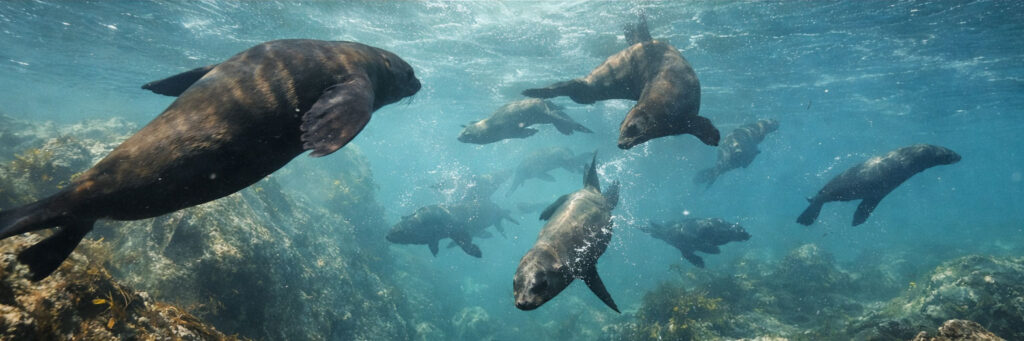
Underwater is where Cape fur seals truly shine.
They use the ocean as a three-dimensional playground, spinning, twisting, blowing bubbles, and racing past one another. This play helps them:
Practise hunting skills
Strengthen muscles
Socialise within the colony
What looks like fun is actually vital training for survival.
What do Cape fur seals eat?
Cape fur seals mainly eat:
Small fish
Squid
Octopus
Crustaceans
They are skilled hunters, using their sensitive whiskers to detect vibrations from prey in dark or murky water.
Can you swim with Cape fur seals in South Africa?
Yes, in certain areas you can join guided snorkelling or diving experiences that allow you to swim near Cape fur seals.
These encounters are usually:
Non-invasive
Closely regulated
Focused on conservation and education
Always choose responsible operators who follow ethical wildlife guidelines.
Are Cape fur seals endangered?
Cape fur seals are not currently endangered, but they face ongoing threats including:
Plastic pollution
Overfishing
Climate change
Entanglement in fishing gear
Protecting healthy oceans is essential for their long-term survival.
Why are Cape fur seals important to the ocean ecosystem?
Cape fur seals play a key role in maintaining marine balance by controlling fish populations and contributing to the natural food chain.
They’re also indicators of ocean health — when seal populations struggle, it often signals bigger environmental problems.
Final thoughts: Why Cape fur seals capture our hearts
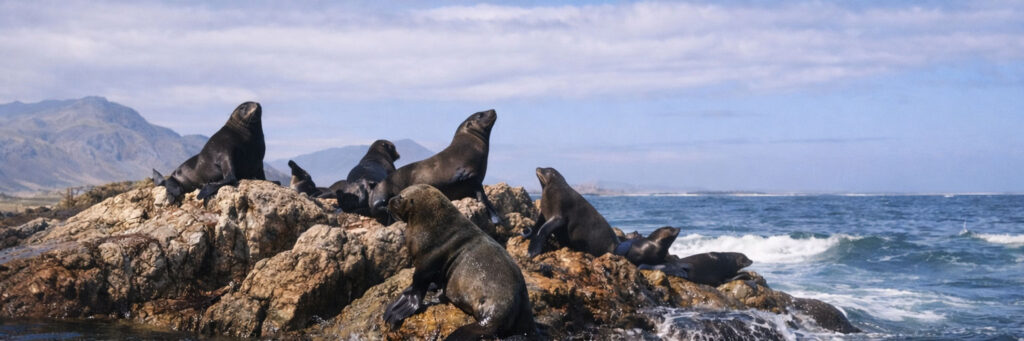
Whether basking on sun-drenched rocks or performing underwater acrobatics, Cape fur seals remind us just how alive the ocean really is.
Watching them isn’t just entertaining — it’s a powerful reminder of why marine conservation matters.
Cape fur seals are frequently spotted in Walker Bay, where their presence is a familiar and much-loved part of the coastal environment. From Hermanus to Gansbaai, these charismatic marine mammals can often be seen resting on offshore rocks, surfacing near boats, or darting playfully through the water while hunting for fish. Walker Bay’s rich marine ecosystem provides ideal conditions for Cape fur seals, offering abundant food sources and safe resting areas close to the open ocean. Their playful behaviour, both above and below the surface, makes them a highlight for visitors exploring the Cape Whale Coast.
One of the most significant Cape fur seal colonies in the region is found on Geyser Rock, a small rocky outcrop located next to Dyer Island near Gansbaai. This island is home to an estimated 60 000 Cape fur seals, making it one of the largest seal colonies in southern Africa. The seals haul out on the rock to rest, breed, and raise their pups, creating a constantly active and noisy colony that can be seen year-round. Geyser Rock lies within a protected marine area, helping to safeguard the seals and the delicate ecosystem they depend on.